Last Updated on October 25, 2026
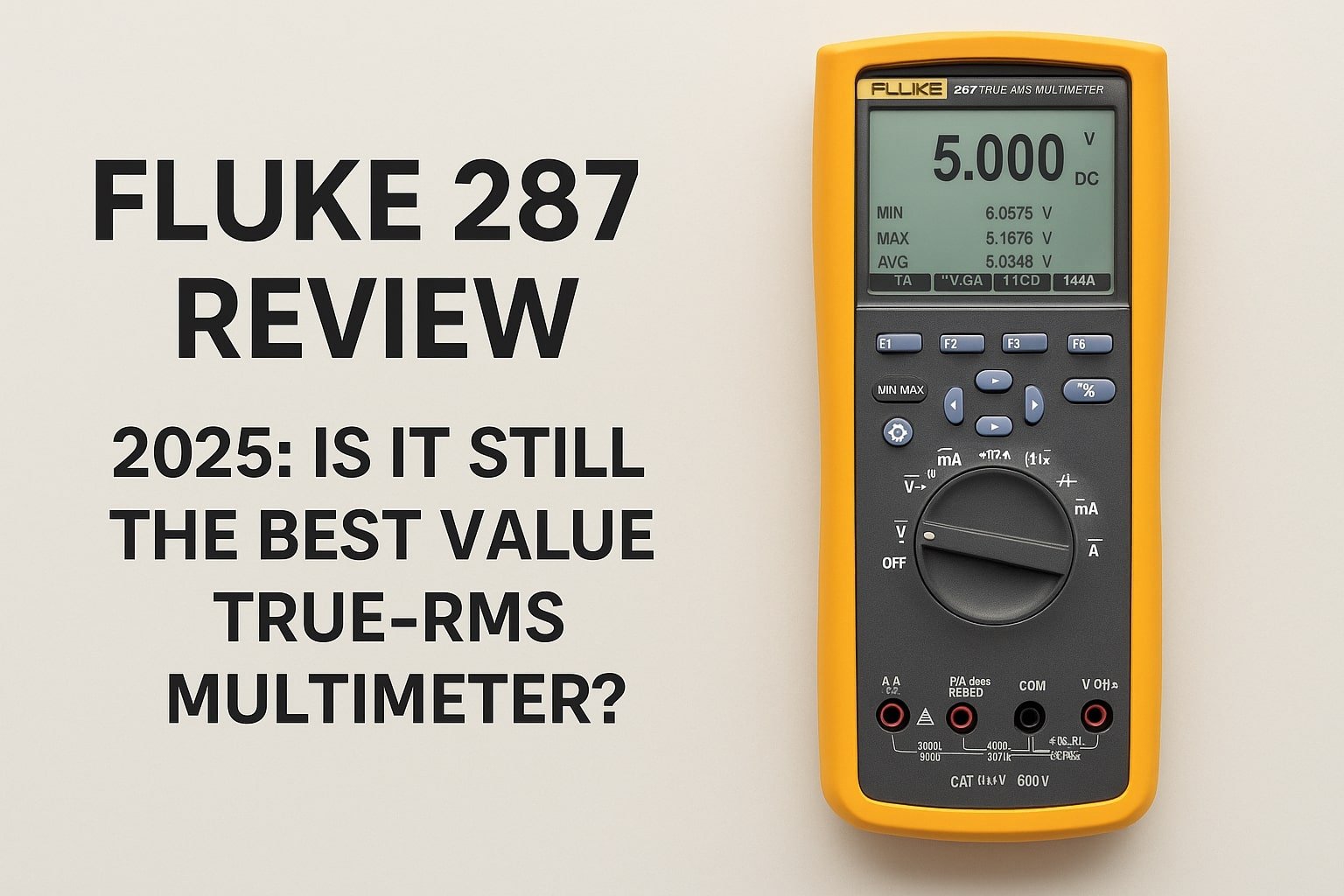
If you’re looking for a professional-grade True RMS digital multimeter with advanced data logging capabilities, the Fluke 287 is an excellent choice. Designed for electronics testing and troubleshooting, it combines accurate measurements with powerful recording and graphing features.
As a slightly more affordable alternative to the popular Fluke 289, the Fluke 287 offers comparable measurement accuracy and logging performance. However, it lacks a few specialized features, including low input impedance (LoZ), low-ohms measurement, and a low-pass filter for motor drive applications.
In this detailed Fluke 287 review, we’ll explore its features, technical specifications, advantages, limitations, and performance. We’ll also compare it with the Fluke 289 to help you decide whether it’s worth buying in 2026.
Fluke 287 Review: Key Features and Specifications
- Measures AC/DC voltage, AC/DC current, resistance, continuity, frequency, capacitance, and temperature with a compatible probe.
- True RMS technology for accurate AC measurements on complex waveforms within specified limits.
- Stores up to 10,000 logged readings or 15,000 events, subject to available memory.
- TrendCapture technology with up to 14x zoom for identifying measurement changes.
- Large 50,000-count, backlit 1/4 VGA graphical display.
- Excellent basic DC voltage accuracy of 0.025%.
- Real-time clock for automatically time-stamping recorded measurements.
- Min/Max/Average recording and peak capture down to 250 microseconds.
- Selectable smoothing filter for stabilizing noisy readings.
- Relative mode for compensating for test lead resistance during suitable measurements.
- Compatible with Fluke Connect using the optional ir3000 FC wireless connector.
- Supports FlukeView Forms software for transferring and analyzing measurements.
- Approximately 100 hours of normal battery operation, with up to 200 hours in logging mode under specified conditions.
- Dimensions: 8.75 × 4.03 × 2.38 inches.
- Weight: approximately 870.9 grams.
- CAT III 1000V and CAT IV 600V safety ratings.
- Limited lifetime warranty.
Included Accessories:
- 6 AA alkaline batteries (installed).
- TL71 premium silicone test leads.
- AC175 insulated alligator clips.
- Quick reference guide.
Optional Accessories: Fluke ir3000 FC infrared wireless connector, TPAK magnetic hanging kit, compatible temperature probe, protective carrying case, and FlukeView Forms software.
Package contents may vary between individual meters and bundled kits, so check the seller’s product description before purchasing.
Complete Review of the Fluke 287 Digital Multimeter
The Fluke 287 is designed for long-term electrical monitoring, electronics troubleshooting, and advanced diagnostics. Unlike basic digital multimeters that only display current readings, this model can record measurements and show how electrical signals change over time.
Its real-time clock automatically adds timestamps to recorded measurements. This makes it easier to identify intermittent faults, unexpected voltage drops, or changes that occur when equipment operates for extended periods.
With TrendCapture technology, users can review recorded measurements directly on the multimeter’s graphical display. You don’t need to transfer every recording to a computer just to identify a trend.
The Fluke 287 also supports event-based and interval logging. Recording settings can be adjusted depending on the type of signal being monitored.
For additional analysis, the optional ir3000 FC connector allows compatible wireless communication through the Fluke Connect system. FlukeView Forms software is another option for storing, documenting, and analyzing readings on a computer.
The multimeter handles a wide range of electrical measurements, including:
- AC/DC voltage up to 1000V.
- AC/DC current up to 10A continuously within specified limits, or 20A for a maximum of 30 seconds.
- Resistance up to 500 MΩ.
- Capacitance up to 100 mF.
- Frequency up to approximately 1 MHz, depending on the selected range.
- Temperature from -200°C to 1350°C with a compatible temperature probe.
The device also provides diode testing, continuity checking, conductance measurement, duty cycle, and pulse-width measurement.
For electricians and technicians who need a wider range of testing instruments, our Fluke multimeter buying guide covers other models designed for different applications.
Data Logging and TrendCapture
Data logging is one of the biggest reasons to choose the Fluke 287.
The meter can store up to 10,000 interval readings or 15,000 recorded events. These limits share the available recording memory, so the actual capacity depends on the logging settings and existing saved data.
TrendCapture converts recorded measurements into a graphical display that helps users identify unusual changes without manually reviewing every reading.
Its zoom feature allows users to examine recorded trends at up to 14 times magnification.
For example, if equipment occasionally experiences a voltage drop, you can leave the meter recording and later check when the change occurred.
Although this feature is excellent for slow and intermittent problems, the Fluke 287 is not an oscilloscope. It cannot display high-speed waveforms in the same way as a dedicated oscilloscope.
Display and User Interface
The standout feature of the Fluke 287 is its large, high-resolution graphical display.
The 50,000-count, 1/4 VGA screen can show multiple sets of measurement information at the same time, including primary readings, secondary values, and recording information.
The white backlight makes the display easier to read in poorly lit environments.
Four function keys provide access to measurement settings, recording features, and other functions. The menu system also includes helpful on-screen instructions and multilingual support.
For professionals who regularly switch between measurements, this design makes the Fluke 287 easier to use than many older multimeters with complicated button combinations.
Fluke 287 Accuracy and Measurement Table
The Fluke 287 offers high accuracy across several electrical measurement functions. The following table summarizes its main specifications.
| Parameter | Measurement Range | Basic Accuracy | Additional Details |
|---|---|---|---|
| AC Voltage | 50 mV to 1000V | 0.4% | True RMS measurement |
| DC Voltage | 50 mV to 1000V | 0.025% | DC mV resolution down to 1 µV |
| AC Current | 500 µA to 10A | 0.6% | 20A maximum for 30 seconds |
| DC Current | 500 µA to 10A | 0.05% | Fused current inputs |
| Resistance | 500 Ω to 500 MΩ | 0.05% | Relative mode available |
| Capacitance | 1 nF to 100 mF | 1.0% | Multiple measurement ranges |
| Frequency | Up to 999.99 kHz | 0.005% | Depends on input signal and range |
| Temperature | -200°C to 1350°C | 1.0% | Excludes temperature probe accuracy |
| Continuity | Audible indication | Not applicable | Built-in continuity beeper |
| Diode Test | Approximately 3.1V test range | Range-dependent | Measures diode forward voltage |
| AC Bandwidth | Up to 100 kHz | Specification-dependent | True RMS AC measurement bandwidth |
The accuracy percentages represent the manufacturer’s basic specifications, not guaranteed accuracy under every condition. Actual measurement accuracy depends on the selected range, frequency, waveform, temperature, and applicable additional digit terms.
Build Quality and Safety
The Fluke 287 is designed for professional use, with a rugged housing, protective holster, and integrated tilting stand.
The meter has CAT III 1000V and CAT IV 600V safety ratings, making it suitable for properly rated electrical measurements in demanding environments.
Its protective features include:
- CAT III 1000V and CAT IV 600V electrical safety ratings.
- Input protection designed for specified transient overvoltages.
- 440mA and 11A fast-acting, high-interrupting-capacity fuses.
- Separate access to the battery and fuse compartments.
- Rugged construction tested for a 1-meter drop.
The meter is designed to meet applicable electrical safety standards, including IEC/EN 61010 requirements.
However, even a properly rated multimeter cannot eliminate electrical hazards. Always follow appropriate multimeter safety precautions, use compatible test leads, and inspect the equipment before testing.
Never exceed the meter’s specified limits. For voltage testing, verify its operation on a known source before and after checking for the absence of voltage.
Fluke 287 vs. Fluke 289: Main Differences
The Fluke 287 and Fluke 289 share many important features, including True RMS measurement, TrendCapture, a graphical display, and data logging.
However, the Fluke 289 includes several additional functions designed for industrial troubleshooting.
Low-Impedance Voltage Mode
The Fluke 289 includes a LoZ function that helps identify ghost voltage caused by capacitive coupling in electrical circuits.
The Fluke 287 does not include this dedicated low-impedance measurement mode.
Low-Ohms Measurement
The Fluke 289 offers a specialized low-ohms function for measuring very small resistance values.
This can be useful when troubleshooting wiring, connectors, and other low-resistance electrical components.
The Fluke 287 can measure resistance accurately, but it lacks the dedicated low-ohms mode found on the 289.
Low-Pass Filter for Motor Drives
Another advantage of the Fluke 289 is its low-pass filter, which is useful when measuring certain variable-frequency drive outputs.
This feature helps reduce unwanted high-frequency components during applicable AC voltage measurements.
For technicians who frequently work with motor drives, the Fluke 289 logging multimeter may offer better value despite its higher price.
Fluke 287 vs. 289 Comparison Table
| Feature | Fluke 287 | Fluke 289 |
|---|---|---|
| True RMS | Yes | Yes |
| DC Voltage Accuracy | 0.025% basic | 0.025% basic |
| Display | 50,000-count, 1/4 VGA | 50,000-count, 1/4 VGA |
| TrendCapture | Yes | Yes |
| Data Logging | Up to 10,000 interval readings or 15,000 events | Up to 10,000 interval readings or 15,000 events |
| LoZ Mode | No | Yes |
| Low-Ohms Function | No dedicated mode | Yes |
| Low-Pass Filter | No motor-drive low-pass mode | Yes |
| Temperature Measurement | Yes, optional probe | Yes, optional probe |
| Fluke Connect Compatibility | Yes, optional adapter | Yes, optional adapter |
| Safety Rating | CAT III 1000V / CAT IV 600V | CAT III 1000V / CAT IV 600V |
| Typical Price Position | Lower | Higher |
| Best For | Electronics troubleshooting and logging | Industrial maintenance and motor-drive troubleshooting |
Which one should you choose?
Choose the Fluke 287 if you primarily need accurate electrical measurements, long-term recording, and graphical analysis.
Choose the Fluke 289 if you also need LoZ, dedicated low-ohms measurements, or low-pass filtering for applicable motor drive troubleshooting.
Fluke 287 Pros and Cons
Pros:
- Excellent basic DC voltage accuracy of 0.025%.
- True RMS AC voltage and current measurements.
- Large 50,000-count graphical display.
- TrendCapture graphing with 14x zoom.
- Advanced data logging and timestamped recording.
- Wide resistance, capacitance, and frequency ranges.
- Min/Max/Average and fast peak capture.
- Strong electrical safety ratings.
- Optional Fluke Connect and FlukeView compatibility.
- Limited lifetime warranty.
Cons:
- More expensive than standard digital multimeters.
- Fluke Connect adapter and FlukeView software are not included in the standard package.
- Temperature probe usually requires a separate purchase.
- Larger and heavier than compact handheld meters.
- No dedicated LoZ or low-ohms mode.
- No motor-drive low-pass filter.
- Backlight and active use can reduce battery life.
- The interface may take time to learn for first-time users.
Is the Fluke 287 Worth Buying in 2026?
The Fluke 287 remains a strong choice in 2026 for professionals who need more than basic electrical measurements.
Its main advantage is the combination of high accuracy, detailed data logging, and graphical TrendCapture analysis.
These features make it particularly useful for electronics engineers, maintenance technicians, and electricians troubleshooting intermittent electrical problems.
However, if you only need to check household voltage, resistance, and continuity, the Fluke 287 may be more advanced than necessary.
A simpler model, such as the Fluke 117 electricians’ multimeter, may be sufficient for routine electrical work.
For users who need advanced industrial troubleshooting functions, the Fluke 289 is worth considering.
Before buying, compare the current selling price, available accessories, warranty conditions, and the features you actually need.
Final Verdict: Fluke 287 Review
Our Fluke 287 review shows that this multimeter is a premium solution for professionals who need precise electrical measurements and detailed long-term monitoring.
Its True RMS technology, graphical display, TrendCapture function, and extensive recording capabilities make it especially useful for troubleshooting electrical and electronic systems.
Although it lacks a few specialized features found on the Fluke 289, the 287 still delivers excellent performance and professional safety ratings.
If your work involves diagnosing intermittent faults, recording changing measurements, or analyzing electrical performance, the Fluke 287 remains a worthwhile investment.
Fluke 287 Review: Frequently Asked Questions
Can the Fluke 287 measure temperature?
Yes. The Fluke 287 supports temperature measurements from -200°C to 1350°C using a compatible temperature probe. The standard package does not normally include the temperature probe.
Does the Fluke 287 come with Fluke Connect?
The Fluke 287 supports Fluke Connect through the optional ir3000 FC wireless connector. The connector must usually be purchased separately unless included in a specific bundle.
Is the Fluke 287 suitable for industrial use?
Yes. Its CAT III 1000V and CAT IV 600V safety ratings make it suitable for many professional electrical environments, provided the equipment is used within its specified limits and proper safety procedures are followed.
How long does the battery last during data logging?
Fluke specifies approximately 100 hours of normal operation and up to 200 hours in logging mode under suitable conditions. Actual battery life depends on settings, backlight use, battery condition, and operating temperature.
What is the biggest difference between the Fluke 287 and 289?
The Fluke 289 includes additional functions such as LoZ voltage measurement, dedicated low-ohms testing, and a low-pass filter for motor-drive applications. Both meters offer True RMS measurements, TrendCapture, and data logging.
How many readings can the Fluke 287 store?
The Fluke 287 can store up to 10,000 interval readings or 15,000 recorded events. These records share the meter’s memory, so the actual capacity depends on the recording configuration and existing saved measurements.
Can the Fluke 287 measure current up to 20A?
Yes, but only for a maximum of 30 seconds under the manufacturer’s specified conditions. The normal current measurement range extends to 10A. Always observe the meter’s current-input limits and required cooling periods.
Does the Fluke 287 have a graphical display?
Yes. It features a large, backlit 1/4 VGA graphical display with a 50,000-count readout. Users can view multiple measurement values and review recorded trends directly on the screen.
Can the Fluke 287 replace an oscilloscope?
No. Although TrendCapture can display changes in recorded measurements, it does not provide the high-speed waveform visualization available from a dedicated oscilloscope.
Does the Fluke 287 have a lifetime warranty?
Yes. Fluke provides a limited lifetime warranty, subject to the manufacturer’s conditions, exclusions, and applicable regional terms.