Last Updated on October 25, 2026
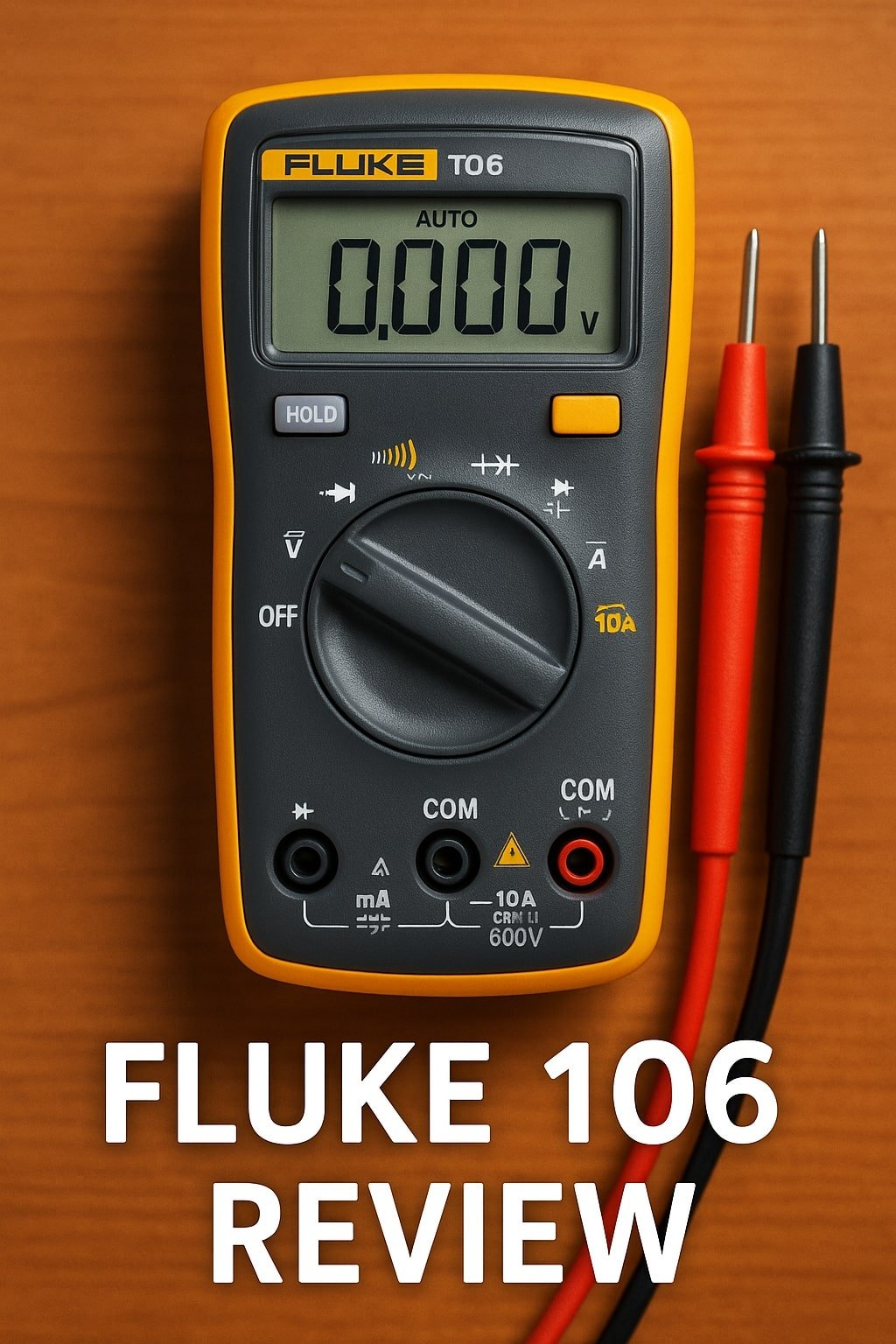
Fluke 106 Review: Overview
The Fluke 106 is a compact, palm-sized digital multimeter positioned between the Fluke 101 and Fluke 107 in Fluke’s entry-level lineup. It’s best suited for home users, hobbyists, trainees, and electricians who need a dependable, easy-to-use multimeter for basic electrical testing.
Despite being manufactured in China, the Fluke 106 offers solid build quality and a CAT III 600V safety rating. It handles common electrical measurements without the extra features or higher price of professional-grade models.
Its compact size makes it particularly useful for technicians who want a lightweight backup meter or anyone who needs something small enough to carry in a toolbox.
However, the Fluke 106 is an average-responding meter rather than a True RMS model. This distinction matters when measuring distorted AC waveforms from variable-speed motors, electronic power supplies, and other non-linear loads.
>> Check Current Price of Fluke 106
Fluke 106 Key Features
- Measures AC/DC voltage, AC/DC current, resistance, and capacitance.
- Maximum voltage measurement of 600V AC/DC.
- Measures AC/DC current up to 10A.
- Audible continuity testing for checking circuits and connections.
- 6000-count LCD for detailed readings.
- Manual range selection using the rotary dial’s function and range controls.
- Data Hold function to freeze measurements on the screen.
- CAT III 600V safety rating under IEC 61010-1.
- Automatic power-off after approximately 20 minutes of inactivity.
- Compact dimensions: 142 × 69 × 28 mm (5.6 × 2.7 × 1.1 inches).
- Lightweight design at approximately 200g (7oz).
- Manufacturer-specified battery life of at least 200 hours under defined conditions.
What’s Included:
- Fluke 106 digital multimeter.
- Two AAA batteries.
- Test leads.
- User documentation.
The exact accessories may vary by seller or regional package, so check the product listing before ordering.
Fluke 106 In-Depth Review
Slightly larger than a typical pocket multimeter, the Fluke 106 is only about an inch thick and has a comfortable, ergonomic design.
It’s designed for everyday electrical measurements, including checking AC/DC voltage, current, resistance, capacitance, and circuit continuity.
Unlike the simpler Fluke 101, the Fluke 106 includes a dedicated current input for measuring AC and DC current up to 10A. This makes it useful for troubleshooting a wider range of electrical equipment.
However, it lacks dedicated milliamp and microamp current ranges, a diode test, and several functions found on more advanced multimeters. It’s therefore less suitable for precision electronics, detailed circuit-board troubleshooting, and specialized HVAC measurements.
The meter’s controls are straightforward, and its display updates approximately three times per second. For basic household and workshop testing, it provides a practical balance between measurement capability and portability.
Fluke 106 Accuracy and Specifications
The Fluke 106 offers useful accuracy for general-purpose testing. Its stated accuracy depends on the measurement function and range.
Accuracy figures below follow the manufacturer’s format: ±(% of reading + digits). Specifications apply under defined operating conditions, generally for one year after calibration.
| Measurement | Range | Accuracy | Resolution |
|---|---|---|---|
| AC Voltage (40–500Hz) | 6V / 60V / 600V | ±(1.0% + 3) | 0.001–0.1V |
| AC Millivolts | 600mV | ±(3.0% + 3) | 0.1mV |
| DC Voltage | 6V / 60V / 600V | ±(0.5% + 3) | 0.001–0.1V |
| AC Current | 4A / 10A | ±(1.5% + 3) | 0.001–0.01A |
| DC Current | 4A / 10A | ±(1.5% + 3) | 0.001–0.01A |
| Resistance | 400Ω to 40MΩ | ±(0.5% + 2) on most ranges; ±(1.5% + 3) at 40MΩ | 0.1Ω–0.01MΩ |
| Capacitance | 50nF to 1000µF | ±(2.0% + 5) on lower ranges; ±(5.0% + 5) on higher ranges | 0.01nF–1µF |
For everyday voltage and resistance measurements, these specifications are sufficient for many common troubleshooting tasks.
However, the Fluke 106 uses an average-responding AC measurement system calibrated for sinusoidal waveforms. If you regularly test variable-frequency drives or distorted AC signals, a True RMS multimeter is a better choice.
Build Quality
While it lacks some of the refinements found on higher-end Fluke multimeters, the Fluke 106 feels sturdy and well-built.
The rotary dial has a firm feel, and the body uses a durable plastic housing. Its small size makes it easy to carry, although the absence of a protective rubber holster means it doesn’t offer the same physical protection as some professional models.
It also lacks a built-in kickstand, which can make hands-free bench testing less convenient.
Battery replacement is simple. The rear battery compartment provides access to the two AAA cells without requiring extensive disassembly.
The Fluke 106 is manufactured in China as part of Fluke’s more affordable multimeter range. Its country of manufacture does not change the manufacturer’s specified safety and performance requirements.
Display and Controls
The Fluke 106 features a 6000-count LCD that refreshes approximately three times per second.
For a compact meter, the display is reasonably easy to read under normal lighting conditions. However, there’s no backlight, which can make measurements difficult to see in dark electrical cabinets or poorly lit workspaces.
The rotary selector keeps operation straightforward, with positions for commonly used measurement functions.
A Hold button freezes the current reading, which is useful when you cannot easily watch the screen while positioning the test probes.
The meter is designed for simple operation rather than advanced measurement customization. Users who need additional functions, such as diode testing, frequency measurement, or a backlit display, should consider another model.
Battery and Power Management
The Fluke 106 runs on two AAA batteries, making replacements inexpensive and easy to find.
According to the manufacturer’s specifications, battery life is at least 200 hours under defined operating conditions.
Because it doesn’t have a display backlight, power consumption remains relatively low during normal measurements.
An automatic power-off feature switches the meter off after approximately 20 minutes of inactivity, helping conserve battery life.
Input Protection and Test Leads
Safety is an important consideration when choosing any digital multimeter, especially one intended for electrical troubleshooting.
The Fluke 106 carries a CAT III 600V safety rating and complies with the applicable IEC 61010-1 requirements.
It also features:
- 11A, 1000V high-interrupting-capacity fuse protection for the current input.
- Specified protection against transient overvoltages within its rated measurement category.
- Shrouded input connections for compatible test leads.
- Maximum rated voltage of 600V between a terminal and earth ground.
The supplied test leads are suitable for ordinary measurements when used according to their ratings and the manufacturer’s instructions.
Always inspect the meter and leads before use. Never attempt to measure voltage while the red lead is plugged into the current input, and disconnect circuit power before making resistance or continuity measurements.
For live electrical testing, use properly rated protective equipment and follow applicable safety procedures.
Fluke 106 Pros and Cons
Pros:
- Compact, lightweight, and easy to carry.
- Measures AC/DC voltage up to 600V.
- Measures AC/DC current up to 10A.
- CAT III 600V safety rating.
- 6000-count display.
- Simple and convenient controls.
- Automatic power-off feature.
- Long manufacturer-specified battery life.
- Reliable construction for everyday use.
Cons:
- No display backlight.
- No dedicated milliamp or microamp current ranges.
- No diode testing function.
- Not a True RMS multimeter.
- No built-in kickstand.
- Limited advanced measurement functions.
Fluke 106 vs. Fluke 101 vs. Fluke 107
If you’re considering the Fluke 106, it’s worth comparing it with the other compact models in the same family.
| Feature | Fluke 101 | Fluke 106 | Fluke 107 |
|---|---|---|---|
| AC/DC Voltage | 600V | 600V | 600V |
| AC/DC Current | No | 10A | 10A |
| Display Counts | 6000 | 6000 | 6000 |
| Capacitance | Yes | Yes | Yes |
| Diode Test | Yes | No | Yes |
| Display Backlight | No | No | Yes |
| True RMS | No | No | No |
| Safety Rating | CAT III 600V | CAT III 600V | CAT III 600V |
The Fluke 101 is the simplest choice for users who mainly measure voltage, resistance, and continuity.
The Fluke 106 adds AC/DC current measurement, making it more versatile for everyday electrical troubleshooting.
The Fluke 107 builds on the 106 by adding convenient features such as a display backlight and diode testing.
For a more detailed comparison, read our Fluke 107 review.
Who Should Buy the Fluke 106?
The Fluke 106 digital multimeter is a good fit for:
- Homeowners: Checking batteries, basic electrical circuits, and household equipment.
- Electrical trainees: Learning voltage, resistance, continuity, and current measurements.
- Hobbyists: Working on simple electrical projects and basic components.
- Electricians: Carrying a compact backup meter for routine testing.
- Maintenance technicians: Performing quick checks on compatible electrical equipment.
However, if you work on sensitive electronics, measure very small currents, or regularly troubleshoot complex AC equipment, you may need a more advanced meter.
Fluke 106 Frequently Asked Questions
1. Is the Fluke 106 a True RMS multimeter?
No. The Fluke 106 uses average-responding AC measurement technology. It is suitable for many basic electrical measurements but may be less accurate on distorted AC waveforms.
2. Can the Fluke 106 measure DC current?
Yes. It measures AC and DC current up to 10A using its dedicated current input. It does not have separate milliamp or microamp ranges.
3. Does the Fluke 106 have a backlight?
No. The Fluke 106 has a standard LCD without a backlight. The Fluke 107 is a better option if you frequently work in low-light conditions.
4. Is the Fluke 106 suitable for automotive testing?
Yes, for basic tasks such as checking battery voltage, continuity, resistance, and suitable current measurements. However, advanced automotive diagnostics may require additional functions or dedicated testing equipment.
5. Can the Fluke 106 test diodes?
No. The Fluke 106 does not include a dedicated diode test function. If this feature is important, consider the Fluke 101, Fluke 107, or another suitable multimeter.
6. How long does the Fluke 106 battery last?
Fluke specifies a minimum battery life of approximately 200 hours under defined operating conditions. Actual battery life depends on usage and battery quality.
Fluke 106 Final Verdict
The Fluke 106 is a reliable entry-level digital multimeter for electricians, trainees, homeowners, and hobbyists who need essential measurements in a compact package.
Its 600V voltage range, 10A current measurement capability, 6000-count display, and CAT III 600V safety rating make it a practical tool for routine electrical troubleshooting.
Although it lacks a backlight, diode testing, True RMS capability, and low-current measurement ranges, its straightforward operation and portable design remain appealing.
For users who value simplicity and don’t require advanced features, the Fluke 106 is a solid everyday multimeter.
Fluke 106 Alternatives
- Fluke 107: Adds a display backlight and diode testing, making it more convenient for everyday electrical work.
- Fluke 101: A simpler model without current measurement, ideal for basic voltage, resistance, and continuity checks.
Optional Accessories:
- Compatible AC Current Clamp: A suitable clamp accessory may extend measurement flexibility, but compatibility, output type, and scaling must be verified before use. The Fluke i400E should not be assumed to work directly with the Fluke 106.
- Magnetic Strap or Hanging Kit: A compatible accessory can provide hands-free operation when securely attached.
- Carrying Case: Protects the meter and keeps test leads organized during transport.