
Last Updated on October 19, 2026
Choosing the right digital multimeter (DMM) is important for electricians, technicians, mechanics, and DIY enthusiasts who need accurate readings and dependable performance. Two well-known names in the multimeter market are Amprobe and Fluke. Both brands offer useful features, but they serve somewhat different needs and budgets.
In this Amprobe vs Fluke multimeter comparison, we’ll look at accuracy, durability, safety, features, pricing, and warranty coverage. We’ll also compare two specific models, the Amprobe AM-510 and Fluke 179, to help you decide which is a better fit for your work.
Amprobe vs Fluke Multimeter: Key Differences
Amprobe and Fluke have both built strong reputations in electrical testing. Amprobe offers a range of affordable meters for home maintenance, electrical troubleshooting, and professional applications. Fluke is particularly popular among technicians who need reliable measurements, rugged construction, and advanced testing capabilities.
However, choosing between these brands isn’t simply about finding the most expensive or feature-packed multimeter. The right choice depends on what you measure, where you work, and how frequently you use the instrument.
To make the differences clearer, let’s compare the Amprobe AM-510 and Fluke 179.
Amprobe AM-510 vs Fluke 179 Specifications
| Features | Amprobe AM-510 | Fluke 179 |
|---|---|---|
| DC Voltage | 400 mV to 600 V Best accuracy: ±(0.8% of reading + 1 digit) |
Up to 1000 V Best accuracy: ±(0.09% of reading + 2 digits) |
| AC Voltage | 400 mV to 600 V Best accuracy: ±(1.0% of reading + 3 digits) |
Up to 1000 V Best accuracy: ±(1.0% of reading + 3 digits) |
| DC Current | Up to 10 A Best accuracy: ±(1.2% of reading + 3 digits) |
Up to 10 A Best accuracy: ±(1.0% of reading + 3 digits) |
| AC Current | Up to 10 A Best accuracy: ±(1.2% of reading + 3 digits) |
Up to 10 A Best accuracy: ±(1.5% of reading + 3 digits) |
| Resistance | Up to 40 MΩ Best accuracy: ±(1.0% of reading + 2 digits) |
Up to 50 MΩ Best accuracy: ±(0.9% of reading + 1 digit) |
| Capacitance | Up to 4000 µF Best accuracy: ±(3.0% of reading + 5 digits) |
Up to 10,000 µF Best accuracy: ±(1.2% of reading + 2 digits) |
| Frequency | 10 Hz to 10 MHz Best accuracy: ±(0.1% of reading + 4 digits) |
Up to 100 kHz Best accuracy: ±(0.1% of reading + 1 digit) |
| Temperature | -40°C to 1000°C (-40°F to 1832°F) |
-40°C to 400°C (-40°F to 752°F) |
| True RMS | No | Yes |
| Safety Rating | CAT III 600 V | CAT III 1000 V / CAT IV 600 V |
| Non-Contact Voltage Detection | Yes | No built-in NCV detector |
| Auto-Ranging | Yes | Yes |
| Backlit Display | Yes | Yes |
| Warranty | 1-year limited warranty | Limited lifetime warranty |
| Best For | Homeowners, DIYers, and general electrical troubleshooting | Professional electricians, technicians, and demanding electrical work |
| Detailed Review | Amprobe AM-510 | Read Fluke 179 Review |
| Price | Budget Choice Check Price |
Professional Choice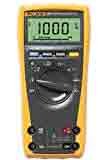 Check Price |
Note: Accuracy figures represent the manufacturers’ best specified accuracy under applicable conditions. Actual accuracy varies by measurement range and function. Check the product listing carefully to confirm the exact model and included accessories before purchasing.
Reliability
Reliability is one of the first things people consider when buying a digital multimeter. An unreliable meter can produce misleading readings, making electrical troubleshooting more difficult.
Amprobe and Fluke have been around for decades. Amprobe traces its history to 1948, while Fluke was also founded in 1948. Both companies have developed trusted electrical testing instruments over the years.
Fluke has a particularly strong reputation among professional electricians and industrial maintenance technicians. Its meters are designed for repeated use in demanding environments.
Amprobe also makes dependable meters, especially for routine electrical maintenance. Models like the AM-510 offer practical features without the higher cost of many professional-grade Fluke devices.
Verdict: Fluke has the advantage for frequent professional use, while Amprobe remains a reasonable choice for everyday electrical testing.
Construction and Durability
Both brands manufacture multimeters with protective housings designed for regular handling. However, construction quality varies between models.
The Fluke 179 features a rugged design with an integrated protective holster. It is well suited for technicians who carry their meters between jobs and use them throughout the day.
The Amprobe AM-510 also has a durable housing and a practical design for general electrical work. For occasional home repairs, it provides a reasonable balance between portability and protection.
Neither meter should be treated as indestructible. A hard fall, damaged test leads, or exposure to moisture can affect performance and safety.
Verdict: Fluke is the stronger option for demanding work environments, although Amprobe provides sufficient durability for many common tasks.
Safety
Safety is an important factor in any Amprobe vs Fluke multimeter comparison. Electrical measurements can be dangerous, particularly when working around distribution panels, industrial equipment, and high-voltage circuits.
The Amprobe AM-510 has a CAT III 600 V safety rating. This makes it suitable for measurements within its specified category and voltage limits.
The Fluke 179 offers CAT III 1000 V and CAT IV 600 V ratings. Its higher measurement-category capability provides more flexibility for qualified professionals working on applicable electrical installations.
One important point is that not every Amprobe or Fluke meter has the same safety rating. The rating depends on the specific model.
Always inspect the meter and test leads before use. Match the meter’s measurement category and voltage rating to the circuit, and never exceed its specified limits.
For additional protection, use properly rated test leads and appropriate personal protective equipment when required.
Verdict: The Fluke 179 offers higher measurement-category ratings than the Amprobe AM-510.
Accuracy and True RMS Measurements
Accuracy is another area where the differences become noticeable.
The Fluke 179 has a basic DC voltage accuracy of ±(0.09% + 2 digits), compared with ±(0.8% + 1 digit) for the Amprobe AM-510 on its specified ranges.
This makes the Fluke 179 particularly useful when small differences in voltage readings matter.
The Fluke 179 also provides True RMS measurement capability. This feature helps it measure AC voltage and current accurately when waveforms are distorted or non-sinusoidal, within the instrument’s specified limits.
The Amprobe AM-510 does not offer True RMS. It is an average-responding meter, so its AC readings are most dependable on the sinusoidal waveforms for which it is designed.
If you frequently test variable-speed drives, electronic power supplies, or equipment producing distorted AC waveforms, a True RMS meter is generally the better option.
Verdict: Fluke 179 wins for basic DC voltage accuracy and True RMS capability.
Ease of Use
Both brands offer multimeters that are relatively easy to operate. The experience depends on the model and the user’s familiarity with electrical testing.
The Amprobe AM-510 has an auto-ranging function, backlit display, data hold feature, and non-contact voltage detection. These features are useful for homeowners and technicians performing basic electrical troubleshooting.
The Fluke 179 also includes auto-ranging, a backlit display, and a straightforward rotary selector. It adds features such as Min/Max/Avg recording that can be helpful when troubleshooting changing electrical conditions.
For someone learning to use a multimeter, either model can be manageable with proper training. The AM-510 may appeal more to budget-conscious beginners, while the Fluke 179 offers additional capabilities for users who expect to perform more advanced measurements.
Related: Klein vs Fluke Multimeter Comparison
Purpose and Applications
Before choosing a multimeter, consider how you plan to use it.
For home electrical maintenance: The Amprobe AM-510 provides useful functions for checking voltage, resistance, continuity, and other basic measurements.
For automotive troubleshooting: Both meters can handle common electrical measurements, including battery voltage, continuity, and resistance checks. However, neither replaces a dedicated automotive diagnostic tool for every task.
For professional electrical work: The Fluke 179 offers better DC voltage accuracy, True RMS measurements, and higher safety category ratings.
For electronics troubleshooting: The Fluke 179 is often the better choice when measurement precision matters. However, specialized electronics work may require additional features not available on either model.
For industrial maintenance: The Fluke 179 is more suitable when its measurement functions and safety ratings match the work being performed.
Cost and Value for Money
Cost is one of the biggest differences between Amprobe and Fluke multimeters.
Amprobe generally offers more affordable options, especially in its entry-level and general-purpose product ranges. The AM-510 provides several useful measurement functions without requiring a large investment.
Fluke meters usually cost more, particularly models designed for professional electrical and industrial applications.
However, a higher price does not automatically make a multimeter the right choice for everyone.
If you only use a meter occasionally to check batteries, outlets, or household electrical components, paying extra for features you rarely need may not be worthwhile.
On the other hand, professionals who depend on their meters every day may find the additional accuracy, True RMS capability, and long-term support worth the investment.
Verdict: Amprobe offers better value for basic testing, while Fluke is worth considering for frequent professional use.
Features
Both companies offer a wide range of functions, but the available features depend on the particular multimeter.
The Amprobe AM-510 includes several practical functions, such as:
- AC and DC voltage measurement
- AC and DC current measurement
- Resistance and continuity testing
- Capacitance and frequency measurement
- Temperature measurement
- Non-contact voltage detection
- Diode and battery testing
- Auto-ranging and data hold
The Fluke 179 includes many of the same basic measurement functions, along with True RMS capability, Min/Max/Avg recording, and a higher DC voltage measurement range.
Interestingly, the Amprobe AM-510 has some convenient features that the Fluke 179 lacks, including built-in non-contact voltage detection. It also offers a wider specified frequency range.
Therefore, Fluke does not automatically win every feature comparison. The better meter depends on which functions you actually need.
Warranty
Warranty coverage is another important consideration, especially when purchasing a multimeter for long-term use.
The Amprobe AM-510 comes with a one-year limited warranty under the manufacturer’s applicable terms.
The Fluke 179 is covered by a limited lifetime warranty, providing additional reassurance for buyers planning to use the meter for many years.
Remember that warranty coverage is subject to conditions and exclusions. Damage caused by misuse, accidents, or operation outside the instrument’s ratings may not be covered.
Verdict: Fluke has the advantage in warranty coverage for these two models.
Which Is Better: Amprobe or Fluke?
After comparing Amprobe vs Fluke multimeters, the answer depends on your budget and intended application.
Choose Amprobe if:
- You need an affordable multimeter for occasional electrical testing.
- You mainly work on household or basic automotive electrical systems.
- You want practical functions without paying for advanced professional features.
- You prefer a meter with built-in non-contact voltage detection.
Choose Fluke if:
- You use a multimeter regularly for professional electrical work.
- You need high DC voltage measurement accuracy.
- You regularly measure AC waveforms that require True RMS capability.
- You need the higher safety category ratings offered by the Fluke 179.
- You value a limited lifetime warranty.
Summary
Both Amprobe and Fluke manufacture useful, reliable digital multimeters, but they appeal to different buyers.
The Amprobe AM-510 is a practical choice for homeowners, DIYers, and technicians who need essential testing functions at a more affordable price.
The Fluke 179 is better suited to professionals who need more precise DC voltage measurements, True RMS capability, rugged construction, and higher safety ratings.
Overall, Fluke has the advantage for demanding professional applications, while Amprobe remains a good option for general electrical troubleshooting.
Before purchasing, compare the exact model specifications and safety ratings rather than relying on the brand name alone.
FAQs
1. Which brand offers better durability, Amprobe or Fluke?
Fluke multimeters are generally well regarded for their rugged construction and long-term professional use. However, Amprobe also makes durable meters, and the actual level of protection depends on the specific model.
2. Are Amprobe multimeters more affordable than Fluke?
Yes. Many Amprobe multimeters are priced below comparable professional Fluke models. They can be a good option for homeowners, DIY enthusiasts, and technicians with limited budgets.
3. Do Amprobe multimeters have the same accuracy as Fluke?
Not always. For example, the Fluke 179 has better basic DC voltage accuracy than the Amprobe AM-510. However, accuracy varies across models and measurement functions, so you should compare individual specifications.
4. Which brand is better for beginners, Amprobe or Fluke?
Amprobe is often a practical choice for beginners because it offers affordable meters with essential testing features. Fluke also makes user-friendly multimeters, although many of its professional models cost more.
5. Are Fluke multimeters worth the extra cost?
For professionals who frequently perform electrical measurements, Fluke’s accuracy, True RMS capability, durability, and warranty coverage can justify the higher cost. Occasional users may find that an Amprobe meter meets their needs at a lower price.
6. Is Amprobe owned by Fluke?
Amprobe and Fluke are associated through Fluke Corporation. Amprobe operates as a brand within the Fluke organization, but the two product lines serve different market segments and price ranges.
thanks, this post was very useful to choose between this brands..
Amprobe vs Fluke is like expert tools vs facom. All functionality capability and durablity is there, but if you want all the bells and whistles you go to Fluke and Facom respectively.